Guides
A walk through Milan's open-air museum
20 APRIL
Every city hides its real self somewhere. In Milan, it's behind the gates of the Cimitero Monumentale.
By Emma Snodgrass
I'll admit it freely: I have a thing for cemeteries. Not in a morbid way, or at least I don't think so. It's more that nowhere else in a city does history become quite so visual, so specific, so human. The grand boulevards and piazzas tell you what a city wanted the world to see. A cemetery tells you what it actually valued. Who it celebrated. What grief looked like in a given era, and how much money someone was willing to spend to make sure it showed.
I've wandered through cemeteries in a dozen countries, and the one in Milan remains one of the most extraordinary places I've ever spent a morning.
The Cimitero Monumentale was designed by architect Carlo Maciachini and officially opened in 1866, built to replace the many unhealthy burial grounds scattered around the city and create a suitable place to celebrate the dead. What Maciachini produced was far more than a functional solution. A wide central lane lined with trees leads from the Famedio along the Ossuary to the Crematorio at the other end, and stretching out on either side are monuments spanning virtually every architectural style of the past two centuries.
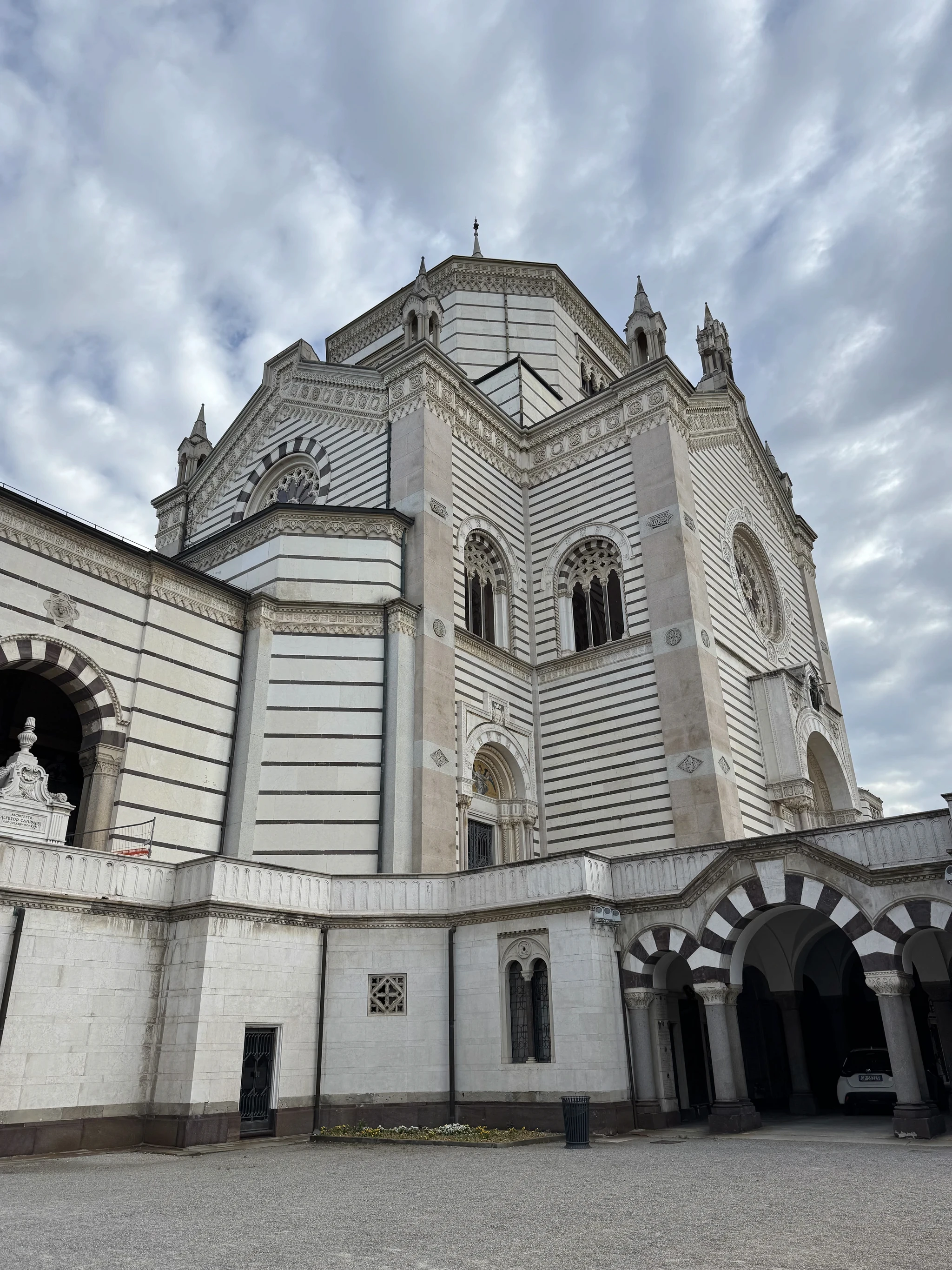
The Famedio stops you in your tracks before you've even entered the grounds proper. Its neo-medieval exterior, large gothic rose window, and decorative floral and geometric motifs set a tone somewhere between church and theatre. Constructed in a neomedieval style of horizontally striped dark red and white stone, the building extends to both the right and left with two galleries of connected arches, through which statue-crowned sarcophagi and tombs overlook the square in front. The Famedio's three main doors, each overlooked by lunettes filled with golden mosaics, lead into a tall, light-filled room topped by a dome decorated with vivid blue paint and golden stars. This is the Tempio della Fama, the Hall of Fame, and it houses the tombs of Milan's most illustrious citizens. The most prominent of them is Alessandro Manzoni, author of The Betrothed and considered the founder of modern Italian literary language, whose tomb sits at the very centre of the Famedio.
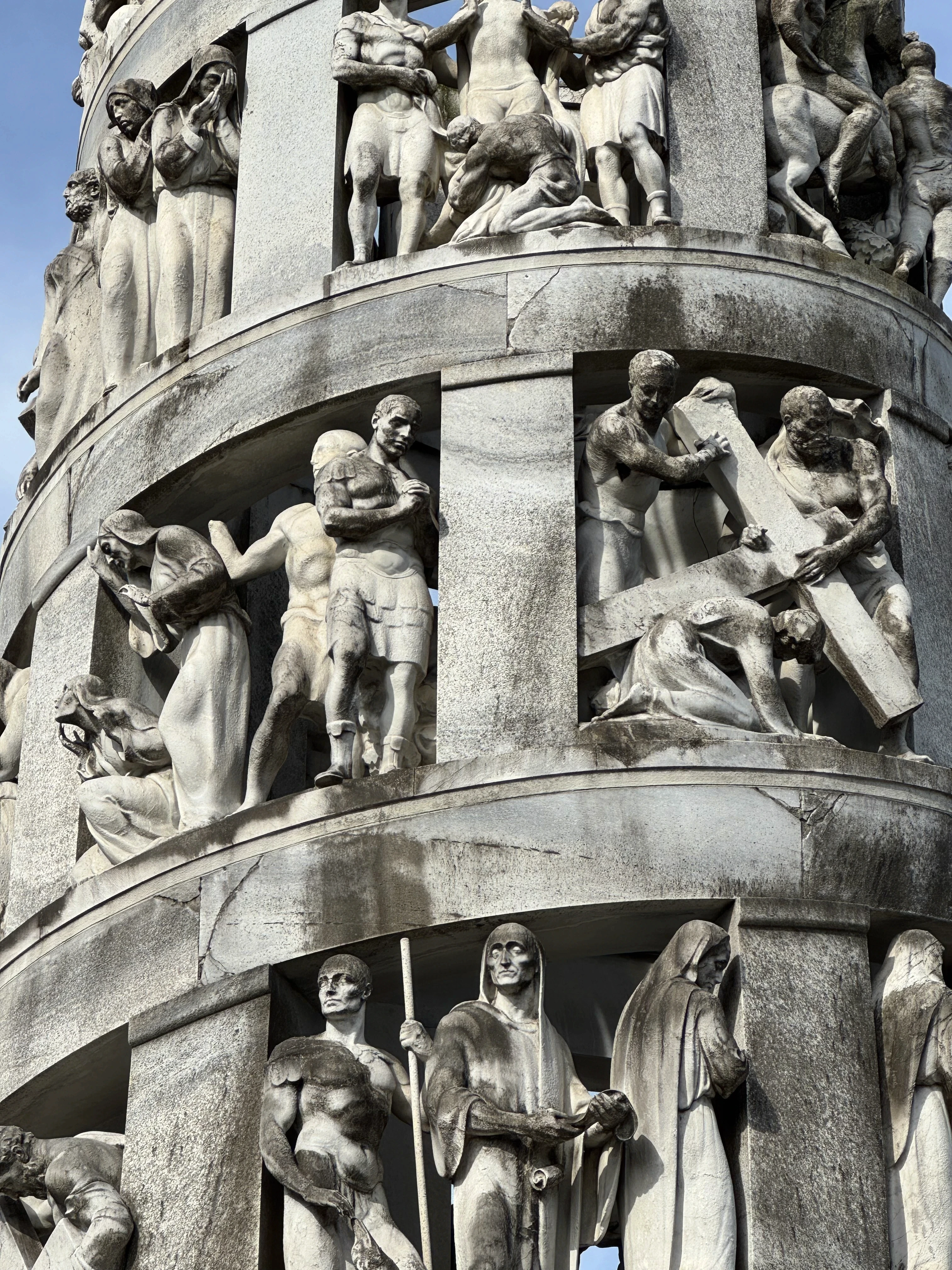
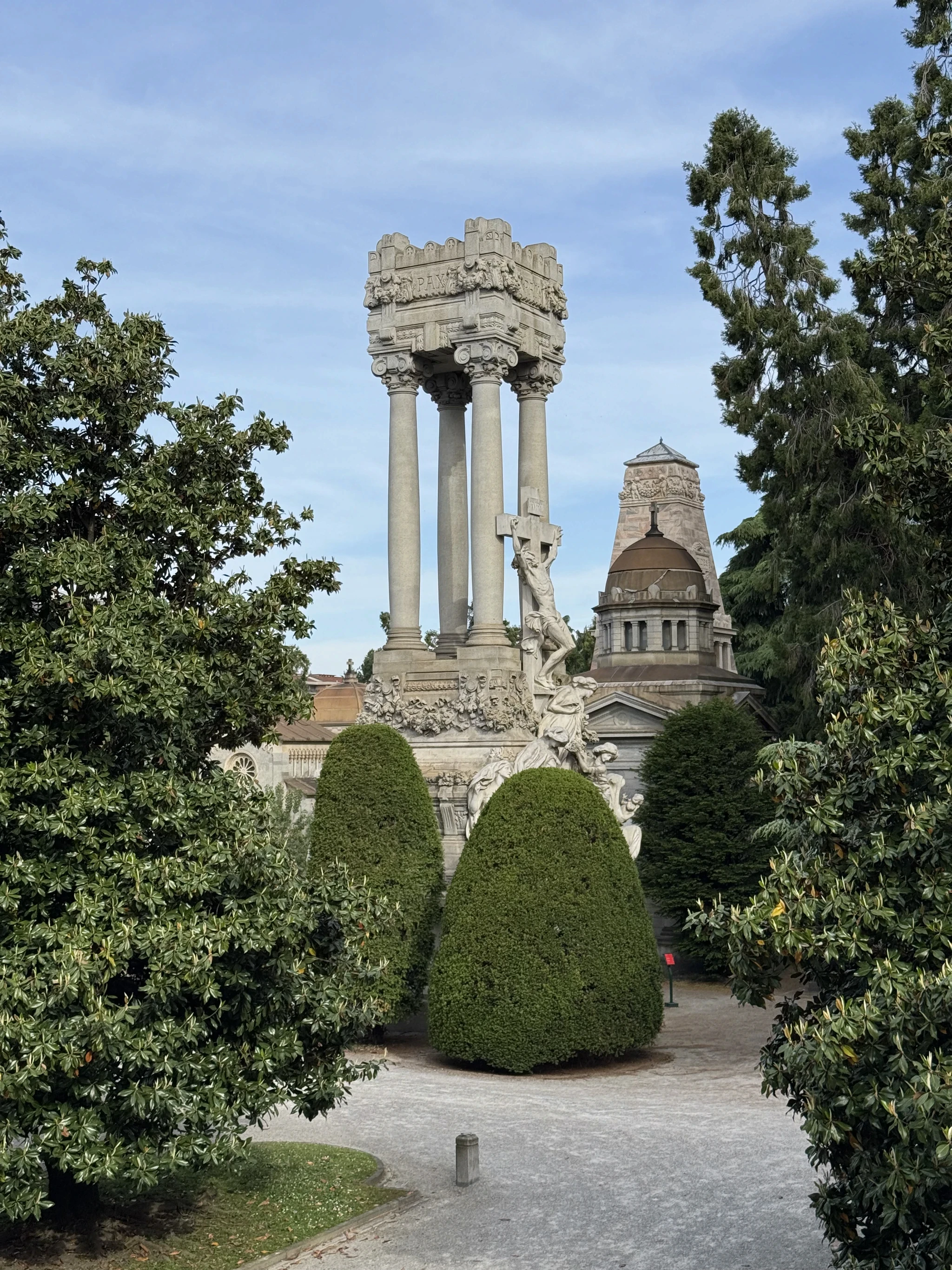
Once you move beyond the Famedio and into the body of the cemetery itself, the experience shifts into something harder to categorise. Milan's wealthy families seemed to try to top each other by building large tombs, often decorated with sculptures of angels, putti, sphinx, and other figures, using every architectural style from Egyptian and Byzantine through to Art Nouveau and post-modern. The result is a walk that rewards wandering. Keep your eyes open for the tomb of Antonio Bernocchi, a pillar evoking the Tower of Babel decorated with intricately carved scenes from the Stations of the Cross; and for the Campari family mausoleum, a reconstruction of the Last Supper with life-sized bronze statues. The Bocconi family tomb, which supports an enormous marble baldachin decorated with statues of mourning women at the foot of a crucified Jesus, is equally arresting.
Next Journal
Travel Journal